Sarah McAdam
Assignment 11; My Choice

SMU students enjoying a sunny day at the pool in Dallas, Texas on April 27, 2026. (©2026 Sarah McAdam/SMU)
For this assignment, I had complete creative freedom, which I quickly realized was both exciting and challenging. Having no restrictions meant I had to be more intentional about what I actually wanted to say with an image. I chose to photograph a summer afternoon by the pool because it captured something that felt genuine... a quiet, unhurried moment in the middle of a warm day.
The arch was what drew me to this particular angle. Rather than simply photographing the pool and the person in it, I wanted to use the structure as a frame within the frame. The columns and curved archway naturally pull the viewer's eye inward, guiding attention toward the subject floating in the water. I liked how the darkness of the covered patio contrasted with the brightness of the scene beyond it, creating a sense of depth that made the image feel more layered and dimensional.
One of the biggest challenges was balancing the exposure between the shaded foreground and the bright, sunlit background. The arch itself was quite dark, while the pool, flowers, and trees were flooded with midday light. I had to adjust carefully so that neither the shadows nor the highlights completely took over the image.
What I enjoyed most was how peaceful the scene felt despite everything happening within it, the cascading water features, the lush greenery, the flowers in bloom. The subject facing away from the camera also felt like the right choice. It invites the viewer into the moment rather than making it feel posed or staged.
Assignment 10; Weather
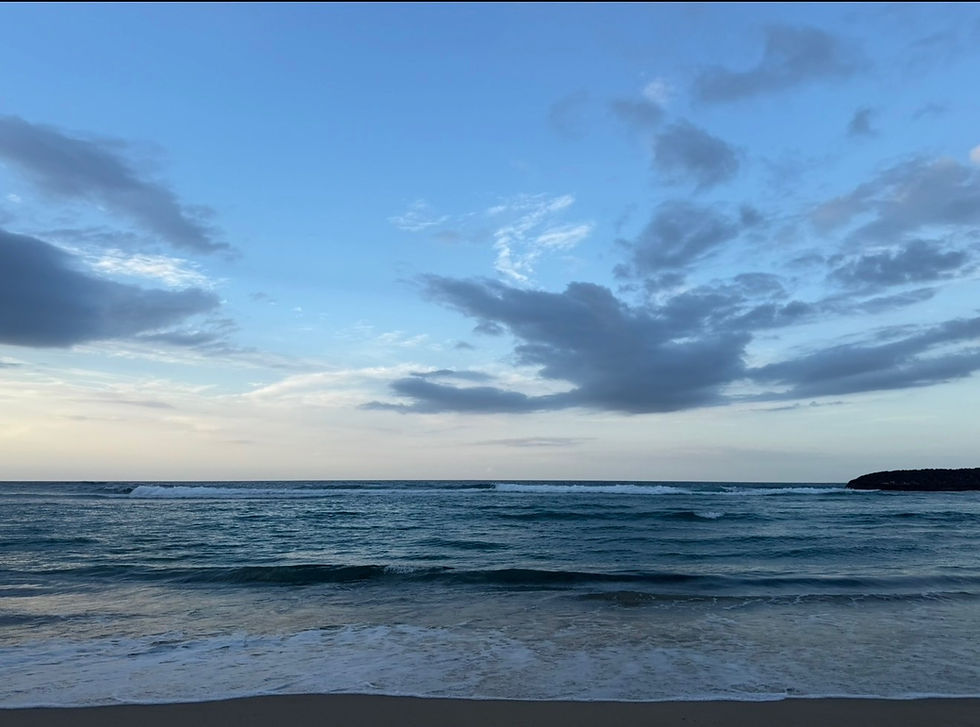
A calm evening in Palm Beach, Florida on April 7, 2026 . (©2026 Sarah McAdam/SMU)
The ocean has always felt like something worth documenting, not for the drama of a storm or the gold of a perfect sunset, but for the quieter in-between moments. This photo was taken at dusk, just as the last of the daylight was fading into a soft, muted glow along the horizon. The sky was doing something interesting — layered clouds drifting over an otherwise open stretch of blue — and I felt like if I didn't stop and capture it, the moment would pass without anyone noticing it had happened at all.
The biggest challenge of shooting weather is that you cannot control any of it. The light shifts constantly, and what looks beautiful to your eye does not always translate through the lens the way you expect. I took several shots trying to balance the brightness of the horizon against the darker tones of the water and the clouds above. Too much exposure and the sky would blow out; too little and the waves would lose their texture and detail.
What I enjoyed most was how still the scene felt despite the movement within it. The waves were rolling in consistently, the clouds were drifting, and yet the overall atmosphere had a kind of calm to it that I found really compelling. I wanted the image to reflect that — something that feels peaceful rather than dramatic, even though a lot is technically happening within the frame.
This assignment pushed me to be more patient. Weather photography does not reward rushing. You have to stand there, watch, and wait for the frame to come together on its own terms.
Assignment 9; Stop Action

Popular DJ, Kaskade, performing his set at Coachella Music Festival in Palm Springs, California on April 12, 2026. (©2026 Sarah McAdam/SMU)
For this assignment, my goal was to capture a moment of movement and energy in a single frame. I chose to photograph a live DJ performance because it naturally creates a sense of motion and excitement. The crowd was constantly moving—hands in the air, people jumping, phones raised—and the performer was at the center of it all, controlling the atmosphere. It felt like the perfect setting to capture a moment that would otherwise pass too quickly to notice.
One of the biggest challenges was the unpredictability of the environment. Everything was happening at once, and there was no way to control what would unfold in front of me. The crowd would shift, people would block the view, and the smoke and lighting would change constantly. I had to stay alert and ready, watching for the right moment when the scene came together in a way that felt balanced and visually interesting.
At the same time, that unpredictability is what made the experience so enjoyable. There was something exciting about trying to capture a single moment in the middle of all that chaos. I found myself more engaged, paying attention to small details like the way people’s hands were positioned or how the performer’s silhouette stood out against the background. It became less about just taking a photo and more about anticipating a moment worth freezing.
Overall, this assignment helped me see how powerful it can be to stop a moment that is usually experienced in motion. A concert is meant to be loud, fast, and constantly changing, but capturing one still image allows you to reflect on it in a completely different way.
Assignment 8; photo essay

A golf cart loaded with bags in preparation for a round of golf at Apogee in Golf Club in Jupiter Florida on March 30, 2026 . (©2026 Sarah McAdam/SMU)

Players set up the score card in preparation for a round of golf at Apogee Golf Club in Jupiter Florida on March 30, 2026 . (©2026 Sarah McAdam/SMU)

Players practice on the putting green at Apogee Golf Club in Jupiter Florida on March 30, 2026 . (©2026 Sarah McAdam/SMU)

Michael McAdam hits a ball from the freeway at Apogee Golf Club in Jupiter Florida on March 30, 2026 . (©2026 Sarah McAdam/SMU)

Players walk to their next shot at Apogee Golf Club in Jupiter Florida on March 30, 2026 . (©2026 Sarah McAdam/SMU)

Players continue their round at Apogee Golf Club in Jupiter Florida on March 30, 2026 . (©2026 Sarah McAdam/SMU)
Golf felt like a natural choice for a photo essay because it already carries a quiet narrative structure—beginning with preparation, moving through moments of action, and ending in reflection. Unlike fast-paced sports, golf unfolds slowly, allowing space to observe both the environment and the people within it. The wide openness of the course, the changing sky, and the deliberate pace of the players created a setting where each image could capture a different part of the story. From the stillness of the landscape to the precision of each swing, golf offered a balance between action and calm that translated well visually.
One of the biggest difficulties I encountered was working with the scale of the course. The landscape is so expansive that subjects can easily feel small or lost in the frame. I had to be intentional about composition—deciding when to embrace that scale to show isolation and when to move closer to highlight detail, like the scorecard or the golf cart. Lighting was another challenge. The bright midday sun created harsh shadows, especially on the greens, while the clouds constantly shifted, changing the exposure from shot to shot. This forced me to adapt quickly and think carefully about angles and timing.
At the same time, those challenges made the process more enjoyable and engaging. I found myself paying closer attention to moments I might normally overlook, like the quiet concentration before a swing or the casual interactions between players. The variety within the environment also kept things interesting—capturing everything from wide scenic shots to small, intimate details helped me tell a more complete story. One of my favorite parts was photographing the action shot, where timing became crucial to capture the motion and energy of the swing against the dramatic sky.
Overall, this project helped me appreciate how much storytelling can exist within a seemingly slow and simple activity.
Assignment 7; Flash

High school student, Elizabeth Resnick, sitting in her living room in West Village, New York on March 25, 2026. (©2026 Sarah McAdam/SMU)
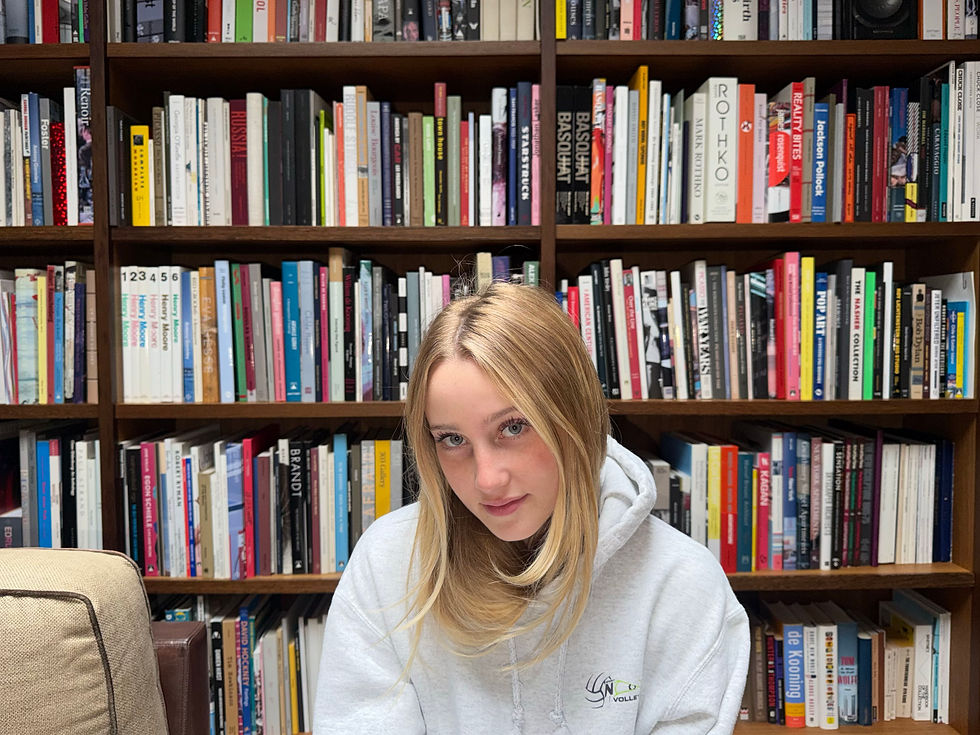
High school student, Elizabeth Resnick, sitting in her living room in West Village, New York on March 25, 2026. (©2026 Sarah McAdam/SMU)
For this assignment, I chose to use my friend as the subject to experiment with an on-camera fill flash. I decided to shoot in front of her bookshelf because it adds visual interest and context, making the image feel more like an environmental portrait rather than just a basic headshot. I liked that the setting felt personal and familiar, which helped keep the photo natural. This assignment made me more aware of how lighting can completely change how a subject's face is seen, especially when dealing with shadows.
The first image without flash showed me how easily shadows can take over a subjects face, even in a well-lit room. While the ambient light from the room and surrounding space was nice, it still created slight shadows around her eyes and under her chin. I noticed that without flash, her features looked a bit less defined and slightly darker than I expected. One thing I did well was keeping her close enough to the camera so the lighting still worked overall, but I could clearly see what I was missing.
When I introduced the fill flash in the second image, the difference became much more noticeable. The flash helped brighten her face and reduce the shadows, especially around her eyes, making her expression stand out more. I liked how the image felt clearer and more balanced, without losing the natural feel of the setting. It didn't overpower the background but instead complimented the existing light, which is exactly what fill flash is supposed to do.
One challenge I encountered was making sure the flash didn't look too harsh or artificial. At first, some of the shots felt a little too bright, specifically on her forehead and nose. I had to adjust my distance and slighting change my angle to get a more even result.
Assignment 6; Environmental Portrait

For my environmental portrait, I chose my friend Sabrina as my subject because she is currently working toward her pilates certification. Pilates is not just a casual hobby for her, but something she dedicates a significant amount of time and energy to each day. She consistently practices, studies technique and form, and is committed to improving her strength and control. Because of this, photographing her in a pilates studio felt like the most natural and effective way to represent who she is right now. The environment plays an important role in the image, with the reformer machines, equipment, and studio layout all acting as visual clues that immediately communicate her craft to the viewer.
In this photo, I wanted to balance both her personality and her practice. Instead of capturing her mid-exercise, I chose a more relaxed pose where she is seated on the reformer, holding a pilates ball. This allows the viewer to clearly see her while still understanding the setting and its purpose. The clean, warm-toned studio and organized equipment help create a calm and focused atmosphere, which reflects the mindset required for pilates. The natural lighting from the windows also adds a soft, flattering look while still keeping the image realistic and grounded in the space.
What I enjoyed most about taking this photo was getting to capture something that my friend genuinely cares about. It was interesting to watch how focused and intentional she became while interacting with the equipment and preparing for the shot. Seeing her confidence in this environment made the portrait feel more authentic and meaningful. It didn’t feel staged, but rather like a moment that represents a real part of her daily life. Being able to document that made the process more engaging and rewarding.
One of the challenges I faced was making sure the composition didn’t feel too busy, since the studio has a lot of visual elements like machines, shelves, and mirrors. I had to carefully position myself so that Sabrina stood out as the main subject while still including enough of the environment to tell the story. Lighting was also something I had to consider, balancing the bright natural light from the windows with the indoor lighting so that the image wasn’t overexposed or uneven. Overall, this assignment helped me better understand how to use environment, composition, and subject together to tell a complete visual story.
SMU student, Sabrina Reale, practicing pilates in Dallas, Texas on March 8, 2026. (©2026 Sarah McAdam/SMU)
Assignment 5; Mastering Depth of Field
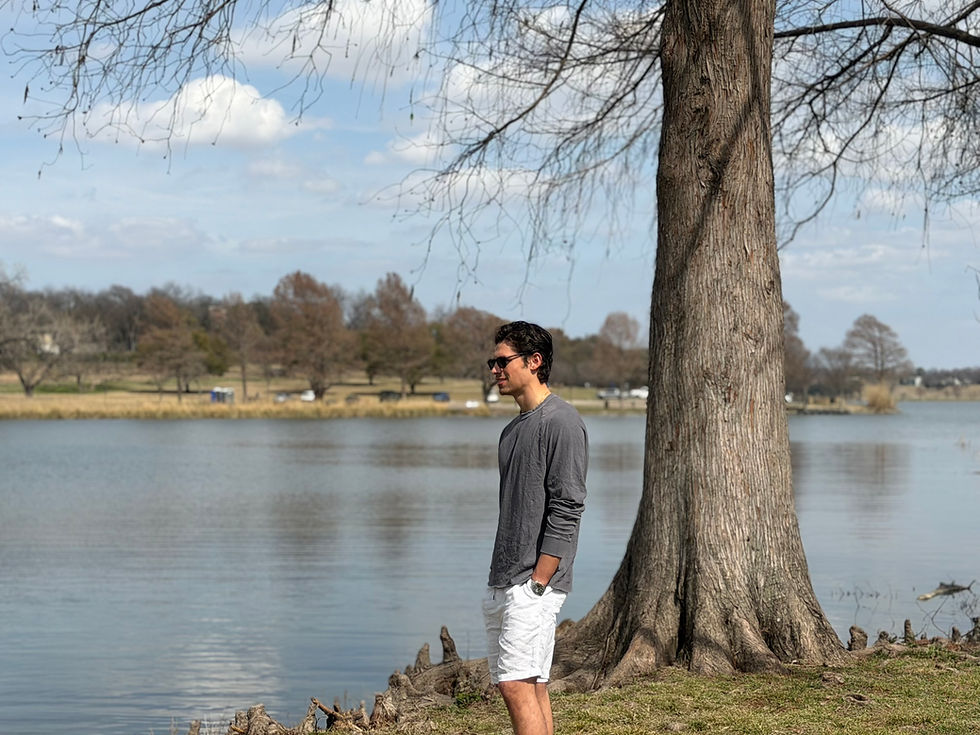
For this assignment, my biggest challenge was learning how to control what the viewer focuses on without overcomplicating the image. Instead of trying to keep everything sharp, I had to be intentional about letting the background blur. I wanted my subject to stand out clearly, while the trees and cars across the water faded softly into the distance. At first, it felt strange not seeing every detail perfectly, but I realized the blur actually made the photo more focused.
Another challenge was being aware of everything happening behind the subject. The lake, shoreline and parked cars could have easily become distracting. I had to shift my position slightly to make sure nothing awkwardly lined up with him or pulled attention away. The tree next to him helped the image because it adds another layer and makes the photo feel more three-dimensional.
I really enjoyed seeing how dramatic the difference could be just by adjusting my settings slightly. It was satisfying to watch the subject stand out so clearly against the softer background. The blur made the image feel calmer and almost cinematic.
I also had to pay attention to focus. Because not everything in the frame was sharp, it was important that the subject was. I had to slow down and make sure that the camera was focusing on him and not the trees or water. This made me more patient and more aware of small details surrounding the subject.
Overall, this assignment taught me that depth of field is about guiding the viewer's eye. By keeping the subject sharp and letting the background soften, the image feels more purposeful.
Boston College sophomore, Thomas Navab, standing at White Rock Lake in Dallas, Texas on March 2, 2026. (©2026 Sarah McAdam/SMU)
Favorite photo: "Kate moss on an elephant" By Arthur Elgort for british vogue 1993

Assignment 4; Rule-of-thirds

SMU student, Julianne Resnick, practicing her yoga poses in Dallas, Texas on February 23, 2026. (©2026 Sarah McAdam/SMU)
For this assignment, my biggest challenge was resisting the urge to center my subject. Centering feels like a safe and natural instinct, especially when I am photographing a single person. However, I had to shift my framing so that her posed body aligned with the left third of the image. At first, the composition felt off-balance, but I quickly realized that this imbalance actually made the image more interesting to look at, especially as she strikes this pose.
Another challenge was managing the background. The wooden fence has bold vertical lines that could compete with the subject. I had to carefully position myself so that these line appeared straight and so the fence panels framed the pose without cutting through her body awkwardly. The strong lines ultimately helped emphasize structure, echoing the extension of her form.
Light was also difficult, as I shot this image in the middle of the day. The bright daylight created harsh highlights and strong shadows on the pavement and shorter shadows on the subject. I had to adjust my angle to avoid overexposing the sky while still keeping detail on the darker details of the image.
Capturing the pose itself also required a lot of patience and timing. Because my subject was balancing on one leg, I had to anticipate the exact moment when her arm and leg would be extended at the same time. A second too early or too late could have made the pose look sloppy and less dynamic. This taught me to be more attentive and ready.
Overall, this assignment helped me understand that composition is very intentional. Blazing the subject on the left third allowed the empty space on the right to suggest movement and direction, making my image feel more alive.
Assignment 3; Shooting in Low Light Sarah mcAdam

For this assignment, I was asked to take a photograph in a low light setting, which I quickly learned was very challenging. I chose to photograph a formal dance in Dallas because the setting naturally fit the dim light requirement with an added twist of fun and movement. The dim atmosphere and string lights created a perfect environment, but made it more difficult to capture the scene clearly.
The hardest part of the assignment was working with such limited light. The room was incredibly dark, with only small areas of brightness from overhead lights. At first, I worried that the image would lose important details, so I had to take several shots in order to find which one best conveyed the atmosphere.
Another challenge was trying to capture the movement. Since everyone was dancing and constantly in motion, nothing was still for an extended period of time. The timing of my shots become essential to the outcome, and I had to wait for a moment that felt natural but not too overwhelming. I wanted to the photo to reflect the vibrant energy in the room, rather than looking like a still, crowded room.
What I enjoyed most about this image is how the low light contributes to the mood of the story pictured. The darkness makes the scene feel intimate, as if the viewer is standing in the middle of the dance floor.
SMU students dancing at a formal event in Dallas, Texas on February 17, 2026. (©2026 Sarah McAdam/SMU)
Assignment 2; Three Types of Light Sarah mcAdam

Julianne Resnick, SMU Sports Management major, looks out the window of her apartment in Dallas, Texas on February 9, 2026. (©2026 Sarah McAdam/SMU)

Julianne Resnick, SMU Sports Management major, stands in the bedroom of her apartment in Dallas, Texas on February 9, 2026. (©2026 Sarah McAdam/SMU)

Julianne Resnick, SMU Sports Management major, hangs up her robe in her apartment in Dallas, Texas on February 9, 2026. (©2026 Sarah McAdam/SMU)
For this assignment, I chose to use my roommate as the subject for capturing three different types of light: directional, diffused, and artificial. I chose to shoot in our apartment because it is a familiar space, and I liked the idea of creating images that felt true to my everyday life, capturing real moments. This project made me much more aware of how much lighting influences the mood of a photograph.
The directional light photo was taken near a window where the sunlight was streaming in strongly from one side. I likes how this added a sense of drama to the image, with clear highlights and shadows shaping my subject's face and profile One thing I did right was positioning her so that the light felt intentional, guiding the viewer's attention. At first, the shadows felt too harsh and overwhelming. After adjusting her angle slightly, I was able to soften the effect while still showing the strong direction of the sunlight.
The diffused light image felt much calmer and even. Diffused lighting spreads gently across my roommate's face, creating a much softer mood. This type of light was easiest to work with because it made the scene feel very natural and balanced. However, I found that this lighting can sometimes look flat . To fix this issue, I paid close attention to framing and background details so the photograph still felt visually compelling. Even the motion of the fan brought the image alive.
The artificial light image was the most difficult to execute. Indoor overhead lighting is not something that is visually appealing, because it can feel less authentic and very stark. In this image, I had to think more carefully about how the light was falling on the subject. I took multiple shots before finding a setup that felt controlled but still realistic. This part of the assignment taught me that artificial light requires a lot more adjustment in comparison to working with natural light sources.
I think each of these images reflect my artistic vision as someone who is drawn to everyday moments. Even though my roommate is the subject, the setting and lighting choices show the way that I see familiar spaces as a perfect opportunity to capture realistic scenes.
Assignment 1; Self portrait Sarah mcAdam

Sarah McAdam, SMU Fashion Media major, prepares a meal in her kitchen, Monday February 2, 2026. (©2026 Sarah McAdam/SMU)
I chose to take my self portrait in the kitchen of my apartment in Dallas because it shows exactly what I like to do with time on my hands. Preparing meals for my friends and I to share has become apart of my daily routine at school. Being able to cook makes home feel not so far away. Everyday, I feel so fortunate to share a home cooked meal with my friends. Although we have such busy lives, we always find the time to connect over dinner.
In this image, I am preparing soup. On Monday’s I always make soup with whatever I have left in my fridge before I go grocery shopping on Tuesday. While this is an element that couldn’t be told just from the image itself, it is a detail that speaks to my resourcefulness. It is a priority of mine to not waste food. I wish I was able to convey this layer of my personality through the image. Another thing I really care about is health, which begins in my kitchen where I prepare healthy and filling meals.
I found using the self timer on my camera to be challenging. Trying to achieve a natural image with such little time to get from behind the camera to in front of it in a natural pose was a struggle. After many tries, I was able to get a photograph that seemed authentic.
Another challenge I faced while creating this image was the lack of natural light that reaches my kitchen. There are no windows in that space, which made it difficult to achieve the natural lighting I prefer for a photograph. I worried that this limitation would negatively impact the quality of the image or make the scene feel too dark. However, after reflecting on how I actually use my kitchen, I realized that this lighting set up was more authentic than forcing something artificial.
The aspect of this process that I felt most confident about was my decision to represent myself through cooking. Cooking felt like the most natural way to show who I am, because it is something that brings me comfort and joy. It is really just an extension of myself. Cooking is representative of not only how I care for myself, but for others as well.